
Why I'm apologizing now
Learning how to actually say sorry

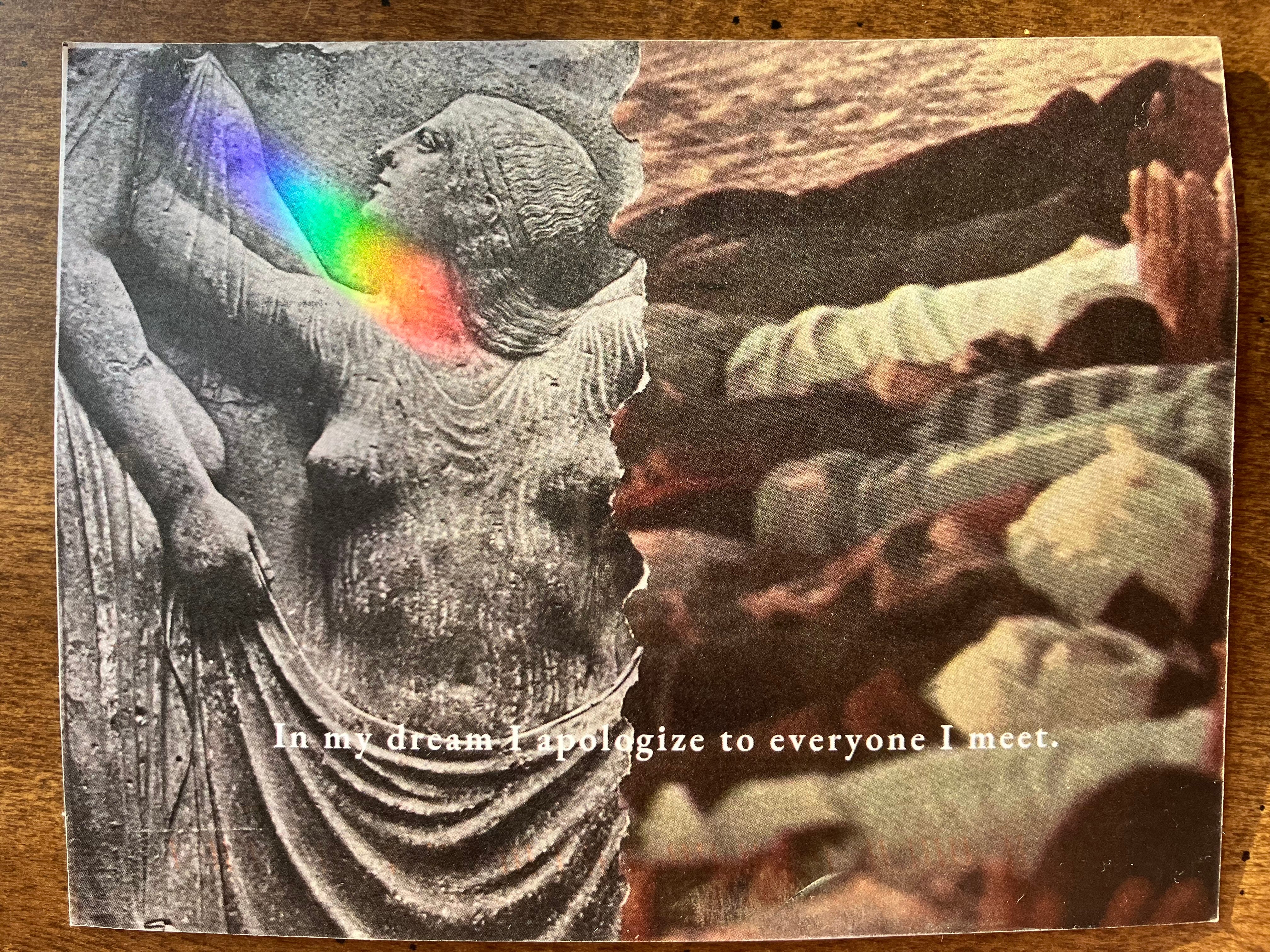
A few months after Valor was born, we began receiving anonymous art postcards addressed to him. It’s always a collage with a quote. We have no idea who they’re coming from, there’s never a message on the back. Last month, the quote was this: “In my dream I apologize to everyone I meet.” Most of the postcards we recycle at the end of the month. But this one, I’ve held onto.
I don’t remember when exactly I learned that over-apologizing was a thing, especially for women, but I do remember realizing, “Oh, I do that.” How did the idea come into my awareness? Was it through the internet? An older girl I thought was cool? One way or another, it took root, and I remember my determination to eradicate the word “sorry” from my vocabulary, the same way I have tried (unsuccessfully) for years to do away with “like.”
I even took to proselytizing other women. A woman would step out of my way in the grocery store and reflexively mutter, “Sorry!” and I’d bark back, “Don’t say sorry!” I remember reading memes on ways to stop over-apologizing: “Instead of saying, ‘I’m sorry for being late,’ say, ‘Thank you for waiting.’” I began to admire people who I noticed never said sorry, and I really tried to stop saying it altogether.
Maybe it’s true. Maybe we do over-apologize. As women, as a culture on the whole. I still try to catch myself when I’m saying “sorry” without really meaning it, when I’m using it as a stand-in for something else. But lately, I’ve begun to think that we also under-apologize. That a true apology is rare to come by, and it’s not something we really know how to do.
I received a powerful apology via email last month. It was one I’d been trying to convince myself for years that I didn’t actually need, but when it came, I cried with relief. I lay on my back and looked up at the late-afternoon clouds high in the pale blue and pink sky, and felt my anger evaporating with them. Even though I’d been doing months of concentrated forgiveness practice, the anger had stayed. Later, I likened it to an activist doing a years-long hunger strike on the steps of the Washington Monument, yelling at passersby, “Don’t look away! Things are still not right!” When the apology came, it was like the hunger striker of my anger could finally go home, eat a meal, and get some sleep.
It felt good. So good, that I found myself hoping the other person felt good having given such an apology. Imagining my way into their experience, imagining that they must be feeling lighter, freer, and perhaps even greater relief. It inspired me to do some clean-up of my own. To take a look at my past, feel into memories that I still cringe at, remember people I’d rather not think about because of some long-past hurt I caused that I still haven’t ever acknowledged or made right.
One day, mid-nurse/nap with Valor, in that hazy oxytocin reverie between sleep and wake, three people came to me. One from middle school, one from high school, and one from just post-college. All of a sudden, the urge to apologize to each of them was there, clear and undeniable. Not to ask for forgiveness, but simply to square myself with the truth of hurt I’d caused. To take responsibility with simple language and offer apology.
The letters took me a few weeks to write. But when they finally flowed out of me I felt free. I tried to keep myself from expecting anything in return. It was hard to do that, because apologizing is vulnerable. It’s offering something that can be accepted or rejected. It’s a humbling, a supplication. When we kneel, we are closer to the ground, closer to the source of all holiness but also closer to being kicked in the face.
I heard back from them: one with genuine warmth and forgiveness, one with a kind but firm boundary, and the third, with silence. It still smarts a little but it’s helping me hone my sense of what true apology is: non-transactional, complete on its own, irrespective of repair or forgiveness.
I grew up in a family where we value being right. We don’t typically do well with feedback. We don’t like hearing that we did anything wrong, ever, and it’s hard for us to admit it when we do. Sometimes we can find it, when it really matters, but more often, not. Five of us were out on a walk together last summer, my parents, my sister, my younger brother and me—a rare constellation these days— and the topic of apologizing came up. How hard it is for us. How defensiveness and blame are our go-to’s. Or worse, justifying what we did and why. I half-joked, “You know who could teach a masterclass on the art of apology? Andrew.” My brother James piped in, “And you know who could co-teach that class with him? Britt.” We then took to extolling our partners’ remarkable abilities to listen, completely take responsibility and offer apology in a way that actually makes things feel better.
Because we all know how it feels to get an apology that doesn’t actually land. I’m sorry you feel that way. Or a slippery one like the one my brother’s roommate gave me when he broke my favorite mug. I’m sorry the mug broke.
Andrew doesn’t over-apologize. He says sorry when he means it. And when he means it, he really means it. As our friend Greg says, Andrew burns clean. He is generous with his apologies, acknowledging little things that he knows might be bothering me. I’m sorry I forgot to switch the laundry over. And he is scrupulous when it comes to apologizing for bigger things. Surveying the entire relational landscape with his sweeping hawks-eye and squaring himself to feeling and acknowledging all the ripple effects his actions may have had. He stands directly in front of me, he looks me in the eye, he says it in plain and clear language, without caveat or justification. His apology game is next-level and has had a profound impact on me in the four years we’ve been together. It’s made me better at apologizing, too.
So why do so many of us struggle with saying sorry? My working theory is that it’s too painful. If there’s a part of us that secretly believes we’re bad or unloveable, acknowledging the harm we’ve caused might threaten our fragile sense of self as proof of the unlovability story. The paradox is that it’s our fear of being bad that keeps us from doing the good thing.
Or maybe we’re afraid it’ll be used against us. I was groped at a concert a few years ago by a friend of a friend (ew) and later, when I told my friend what had happened, he asked me if he could confront his friend about the groping. “We men need to talk to one another about these things, or else they’ll keep happening,” he said and I was like, sure. He asked me if I wanted anything from the guy, and after considering I said, “I mean, I guess an apology would be nice?” Later he relayed to me that the groper didn’t want to make any kind of written apology, because he was afraid it would be used against him in a court of law. No joke. This was back in 2017, peak #MeToo, and any kind of sexual misconduct allegation was kryptonic. So that apology never came.
I lost my patience with Valor the other day. He’s in a phase where he won’t lie down for a diaper change, so we are doing standing diaper changes. It works if he stays standing, but sometimes he wants to sit back down. And this kid is big. Almost thirty pounds. And it felt like diaper number seven hundred of the day, my back and arms were sore, there was poop everywhere, and I was trying to keep him standing with one hand while cleaning him with the other and I just lost it. Losing it, at that moment, meant speaking harshly and handling him with more force than necessary. It didn’t feel good. Once I got a clean diaper on him, I put him in his Pack-n-Play and went into the other room to take a few moments and breathe. He cooed happily, slapping the hand pan and babbling to himself. I could hear his sweet sounds as I came down. When I came back into the room he was standing up, holding onto the railings, beaming at me. I got down to his eye level. “I’m sorry I lost my patience with you, little man. I’m sorry I spoke harshly and was rough. I am trying so hard and you are helping me learn so much, and I’m sorry I don’t always get it right. Thank you for your patience with me as I learn how to do this thing with you. You’re safe, and lovable, and I love you.” I kissed him, and he smiled.
And so it goes. We pass down to our children both the things we want and don’t want to. I don’t know what Valor will inherit from me or from his dad. All I know is that we’ll keep apologizing to one another, hearts open and bared, learning as we go. We won’t always get it right, and I’m starting to realize that maybe getting it right isn’t even the point.
Because the best kept secret about apologizing is that it can feel amazing. When I can connect with the deeper truth that I am not what I’ve done, I am free. I can take responsibility for the awful things I’ve done, call them home, and remain whole in the process. I used to fear that taking responsibility for harm I’ve done would diminish my power. But it’s the opposite. It’s a reclamation and an amplification of my power.
I’m still learning how to do it. I can still feel when there’s a little barb of blame or a slippery justification wriggling its way into an apology, souring the milk. And then I get to try again.
I can feel when I land it. When I take it, as we like to say, directly to the chest. It feels good.
Beautiful piece, and so true! As I’m sure you know, making amends is the 9th step of recovery in AA (and, I assume, other 12-step programs). My amends-writing and -making process has been so meaningful and valuable and has taught me a lot. You are so right about having to send the apology off into the world, fully formed, without expectation or strings attached. It’s so freeing to have “my side of the street clean,” as they say. And I have SO been there with speaking harshly/rough handling (I have two boys ages 3 & 1). I just break my own heart when it happens (infrequently, thankfully). When I get like that I have found it’s always a warning signal that I need something - a snack, a break, etc. My therapist assures me that the “repair” is valuable to these beautiful, wonderful, innocent, frustrating, crazy-making little people!
Such a beautiful piece, thank you :)